
SEO vs Paid Ads: Which Is Better for Business Growth?
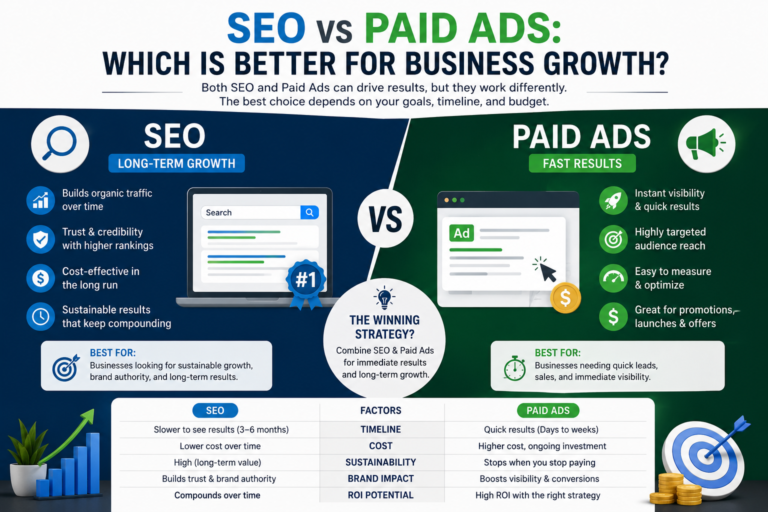
This question comes up constantly, usually from a founder who’s just burned through a chunk of their marketing budget and wants to know if they should have spent it differently. And honestly? The question itself is a little broken.
It’s not SEO or paid ads. It’s understanding what each one is actually good at, and being honest about what stage your business is in. Let’s walk through how this actually plays out in practice, not the textbook version
It’s not SEO or paid ads. It’s understanding what each one is actually good at, and being honest about what stage your business is in. Let me walk you through how I actually think about this, not the textbook version.
The Honest Truth: They Solve Different Problems
Paid ads are rented attention. The moment you stop paying, the traffic stops. I’ve watched businesses run a great Google Ads campaign for six months, see fantastic numbers, pause spend to “regroup,” and watch their pipeline go to zero within days. That’s not a flaw in paid ads – that’s just what they are. You’re renting a spot at the top of the page.
SEO is owned attention, or at least as close to “owned” as you get on the internet. It compounds. It’s slow, it’s frustrating in the early months, and it rewards patience most agencies don’t want to admit clients don’t have. But a well-optimized page you built eight months ago can still be pulling in leads today without you touching it.
Neither of these is “better.” They’re different tools solving different timelines.
When Paid Ads Actually Win
I’m not anti-paid-ads. I run Google Ads and Meta Ads campaigns for clients constantly, and there are situations where they’re clearly the right call.
- You need revenue now, not in six months. If you’ve got a new product launch, a seasonal window, or you simply need cash flow this quarter, SEO cannot move fast enough. Paid ads can put you in front of a buyer-intent search today.
- You want to test messaging before committing. One underused advantage of paid ads is that they’re a research tool disguised as a marketing channel. I regularly run small Meta Ads tests to figure out which headline, offer, or audience actually converts – then feed those insights into organic content and landing pages later. It’s cheaper to learn what doesn’t work with a $20/day test than to build an entire content strategy around a hunch.
- Your market is hyper-competitive and young domains can’t rank. If you’re in a space where the top 10 organic results are all sites with a decade of authority behind them, realistically ranking on page one could take a year or more. Paid ads let you compete on day one.
The catch: paid ads get more expensive over time, not less. Auction dynamics mean as more competitors bid on the same keywords, your cost-per-click climbs. I’ve seen CPCs in competitive niches double in eighteen months. If your entire growth engine depends on ad spend and nothing else, you’re vulnerable to your own success – the better everyone else gets at ads, the more you pay for the same result.
When SEO Actually Wins
- You’re playing a multi-year game. Most of my clients who treat SEO seriously start seeing meaningful traction somewhere between month four and month eight, not week two. That timeline kills a lot of impatient SEO strategies before they get a fair shot. But once it kicks in, the math changes completely – you’re not paying per click anymore.
- Trust matters in your buying decision. People click on organic results differently than they click on ads. There’s still a subconscious “this one earned its spot” bias, especially in B2B, healthcare, finance, and anything high-consideration. I’ve had clients tell me leads from organic search close at noticeably higher rates than leads from paid campaigns, simply because the buyer feels like they found you, not that you found them.
- You want content that keeps working. This is the part people underestimate. A blog post, a well-structured service page, or a strong FAQ schema markup doesn’t just rank – it becomes an asset. It answers customer questions your sales team would otherwise answer manually, over and over, forever. That’s not “traffic.” That’s leverage.
The catch: SEO punishes shortcuts. Thin content, keyword stuffing, ignoring technical fundamentals like page speed and mobile experience, or chasing every algorithm update instead of building genuinely useful pages – all of it eventually gets found out. Google’s gotten much better at recognising content built for humans versus content built to game rankings, and that gap is only going to widen.
What Nobody Tells You: The Real Answer Is Both, Sequenced Correctly
Here’s the strategy I actually use with clients, and it’s less exciting than “pick a side” but it’s what works.
- Early stage / new domain: Lean paid. Use it to generate immediate revenue and, more importantly, to gather data – what converts, who your actual customer is, which pain points close deals. Don’t just run ads blind; mine every campaign for insight.
- Mid-stage: Start SEO in parallel, using what paid ads taught you. If a Google Ads keyword converts at a high rate but costs $8 per click, that’s a strong signal it’s worth building organic content around, because ranking for it organically eventually removes that $8 cost entirely.
- Mature stage: SEO becomes your baseline, and paid ads become a precision tool – retargeting people who visited but didn’t convert, promoting a specific offer, or defending your brand name in search results from competitors bidding on it (yes, that happens more than people realise).
I’ve seen businesses try to skip straight to “SEO only” because it’s cheaper, and stall out because they had no data on what messaging actually converts. I’ve also seen businesses stay on “paid only” for years and basically build a business with no equity in it – the second they stop spending, there’s nothing left.
A Quick Gut-Check for Your Own Business
Ask yourself these questions honestly:
- Do I need pipeline this month, or can I invest in something that pays off in six to twelve months?
- Is my market one where trust and research-driven buying matter, or is it impulse-driven?
- Do I have (or can I get) the budget to sustain paid ads long enough for CPCs and conversion data to stabilize?
- Am I willing to invest in content and technical SEO consistently, even when the early results look unimpressive?
Your answers usually point pretty clearly toward where your first dollars should go.
The Bottom Line
If someone tells you SEO or paid ads is universally “better,” they’re either selling you one of the two, or they haven’t managed both long enough to see where each one breaks down. The businesses that grow sustainably are the ones that use paid ads for speed and data, and SEO for durability and trust – and know exactly when to shift weight from one to the other as the business matures.
This is the answer that keeps holding up in practice – not the easy one, not the trendy one, just the one that consistently works, campaign after campaign, client after client.
Need Help Improving Your SEO?
If you’re struggling with declining rankings, low organic traffic, or keeping up with Google’s latest updates, a tailored SEO strategy can make all the difference.
Whether you need an SEO audit, content strategy, or ongoing SEO support, I’d be happy to help you identify opportunities and create a plan for sustainable growth.