
Be honest: Have you ever read an article about the Google algorithm that just gives you a list of 200 ranking factors?
That’s not what we have here.
In fact, in the next few minutes, you’ll learn how the Google search algorithm really works in 2026, no fluff included. This guide is for marketers, business owners, website creators, and any other SEO curious individual who’s been following everything but failing to rank anyway.
Why?
Because Google has changed. A lot. The things that got you rankings in 2022 and 2024 may very well be the reason you aren’t ranking in 2026.
Let’s dig in.
What Is Google’s Algorithm?
Imagine that Google search algorithm is an incredibly knowledgeable and opinionated librarian.
If you come to the librarian with a question about “the best Italian restaurant nearby,” he won’t give you all books containing the word “Italian” on their covers; instead, based on your personal preferences, geographic location, previous searches, and what other users who shared similar preferences found useful, he will tell you the most relevant information within seconds.
That’s Google. By essence, it is a technology that provides a user with the most suitable response to his/her search query.
Now imagine what that technology is like in 2026.
How Google Search Algorithm Really Works
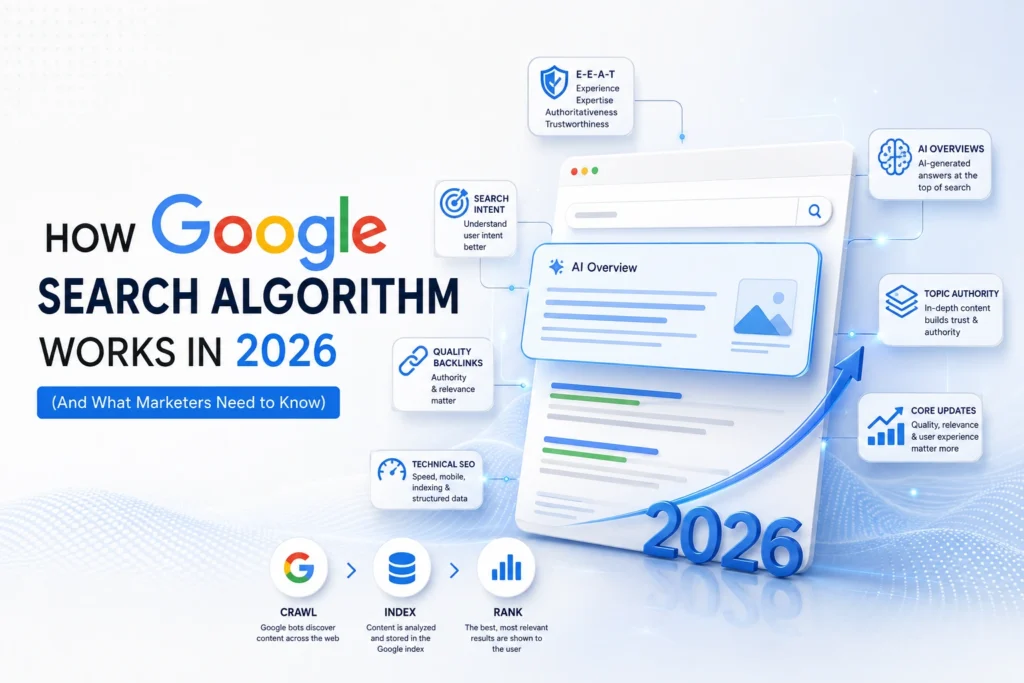
The Google search algorithm uses hundreds of factors in order to rank its content. However, there are basically three stages to the entire process:
1. Crawl — Google has bots that constantly crawl the internet, finding pages.
2. Indexing — The content found by the bots is indexed by Google into what’s called the Google Search Index.
3. Rank — When a search takes place, Google uses the indexed data to find pages and rank them.
This all sounds very simple. So far, anyway. It gets more complicated when you consider how Google ranks the pages.
What Is Really Moving The Needle On Rankings In 2026?
1. Ignoring E-E-A-T Could Cost You Rankings
Never heard of E-E-A-T? Well, it’s time you did.
Experience, Expertise, Authoritativeness, and Trustworthiness: that’s what it’s all about in 2026, and that’s how Google assesses content quality.
Google looks for evidence that someone has true experience with the topic on which he or she writes. That means not just regurgitating facts, but providing in-depth, personal insight with evidence-based credibility.
What this means for you: Your content should be a reflection of yourself. Sign your name. Provide personal perspectives. Back up your claims with hard evidence, whether statistics, research, or real-life experiences. It doesn’t matter if it’s just a blog post – build an author biography.
2. Search Intent Always Outweighs Keyword Stuffing
This is one of the greatest changes that many marketers have yet to adjust to.
It’s not only important to understand what keywords are used in the query – Google can interpret the true intention of the user when entering the search. And misunderstanding the user’s intention would negatively impact your rankings no matter how optimized your page is.
There are four types of search intent:
Informational search intent — “How does the Google algorithm work?”
Navigational search intent — “Google Search Console login”
Commercial search intent — “Best SEO tools 2026”
Transactional search intent — “Hire SEO consultant in Dubai”
The person who searched for “how to conduct a keyword research” will not be served by a page which aims to convince the users to hire an SEO consultant. Because their search was informational, not commercial.
3. AI Overviews Will Change the Game for You Too
Google AI Overviews (originally called SGEs) are appearing at the top of many pages for searches in 2026. This means that the content displayed comes directly from authoritative sources without the user ever having to click a link.
Both challenges and opportunities arise out of this.
Challenge: CTRs will go down even if you rank on page one.
Opportunity: Your content might be so great that Google puts it into an AI Overview — placing your brand even above the search results.
To make sure this happens, you need:
- Well-structured answers to specific questions
- Headings and bullet points
- Topical authority
4. Topic Authority Over One-Time Blog Posts
There is something most business owners do not realize: Posting an amazing blog post on their site does not make much of a difference anymore.
Google will analyze the entire site. What can Google ask itself in this scenario? Is this website an expert in the field of the topic it discusses? The answer being “Yes,” the site gets rewarded with what is called topic authority – and thus the site ranks better.
This way, instead of posting some random stuff, we should have a solid content strategy. Create content clusters. Have a pillar page on a general topic and write articles covering various subtopics on the same general topic.
5. Core Updates Happen More Often — and Make Bigger Changes
There were two significant core updates from Google in March and April 2026, during which many sites suffered fluctuations in their rankings because of new requirements for quality, relevance, and credibility of the content. If your site had low rankings, it didn’t mean you did anything wrong. Google simply recalculated everything according to the new criteria.
Elements that get penalized in the core update:
- Content generated by algorithms without any useful information
- Pages that do not match the user intent
- Sites with insufficient authority in the specific topic
- Bad user experience
- Things that work well during core updates:
- Well-studied and relevant content
- Sites with regular updates and good coverage of the topic
- Pages solving the user’s problem
6. Technical SEO Is Still Essential – Don’t Overlook It!
Technical SEO in 2026 isn’t going anywhere. While content and other elements of the marketing mix are critical, it doesn’t matter how high-quality the content is if Google cannot index it properly, does not see it due to a lack of speed, or if it doesn’t work correctly on mobile devices.
The main technical aspects you need to be familiar with include:
Core Web Vitals – Page loading times, visual experience, and interaction continue to be ranking factors for Google. This means that a poorly performing website will harm your chances.
Mobile-First Indexing – Google indexes websites from the mobile version first. It means that if your mobile website sucks, you are harming your desktop search presence too.
HTTPS – Google prefers HTTPS to plain HTTP when indexing a website.
Structured data / Schema markup.
7. Backlinks Are Still Important – But It’s All About Quality
Backlinks aren’t dead yet. They remain one of Google’s most dependable indicators of authority. However, everything about backlinks changed and became all about quality rather than quantity.
Just one backlink from an authoritative source within your niche can prove far more valuable than 100 backlinks from any other unrelated site. Google can instantly tell if you’re employing some kind of link scheme or if your backlinks come from a shady link building campaign.
Concentrate on creating valuable content and relationships in your industry that will earn you links.
This Is What It Means For Marketers Today
If you’re an SEO marketer for your company or personal brand, you can apply these tips today:
✅ Audit your content – Eliminate thin pages that don’t provide anything of value
✅ Make sure each page serves a specific purpose – informational, commercial, transactional
✅ Create your own E-E-A-T – Include author information, expertise, authority, experience
✅ Create a content cluster plan – No more scattered blog posts, add depth to your topics
✅ Create content for Google AI overviews – Use headings, be informative, include summaries
✅ Get your technical SEO in order – Optimize page speed, mobile version, Schema, CWV
✅ Get quality backlinks – Don’t focus on quantity, make sure they’re relevant
✅ Monitor core updates – Understand how and why certain pages were impacted by the update
The Bottom Line
The algorithm created by Google in 2026 is not here to fool you. Rather, it is meant to provide genuine value, authenticity, and quality content to its users.
The successful marketers are not manipulating the system either; they create actual value, build authority, and consider the needs of the consumer above all else.
In fact, it’s how things should work.
Need Help Improving Your SEO?
If you’re struggling with declining rankings, low organic traffic, or keeping up with Google’s latest updates, a tailored SEO strategy can make all the difference.
Whether you need an SEO audit, content strategy, or ongoing SEO support, I’d be happy to help you identify opportunities and create a plan for sustainable growth.